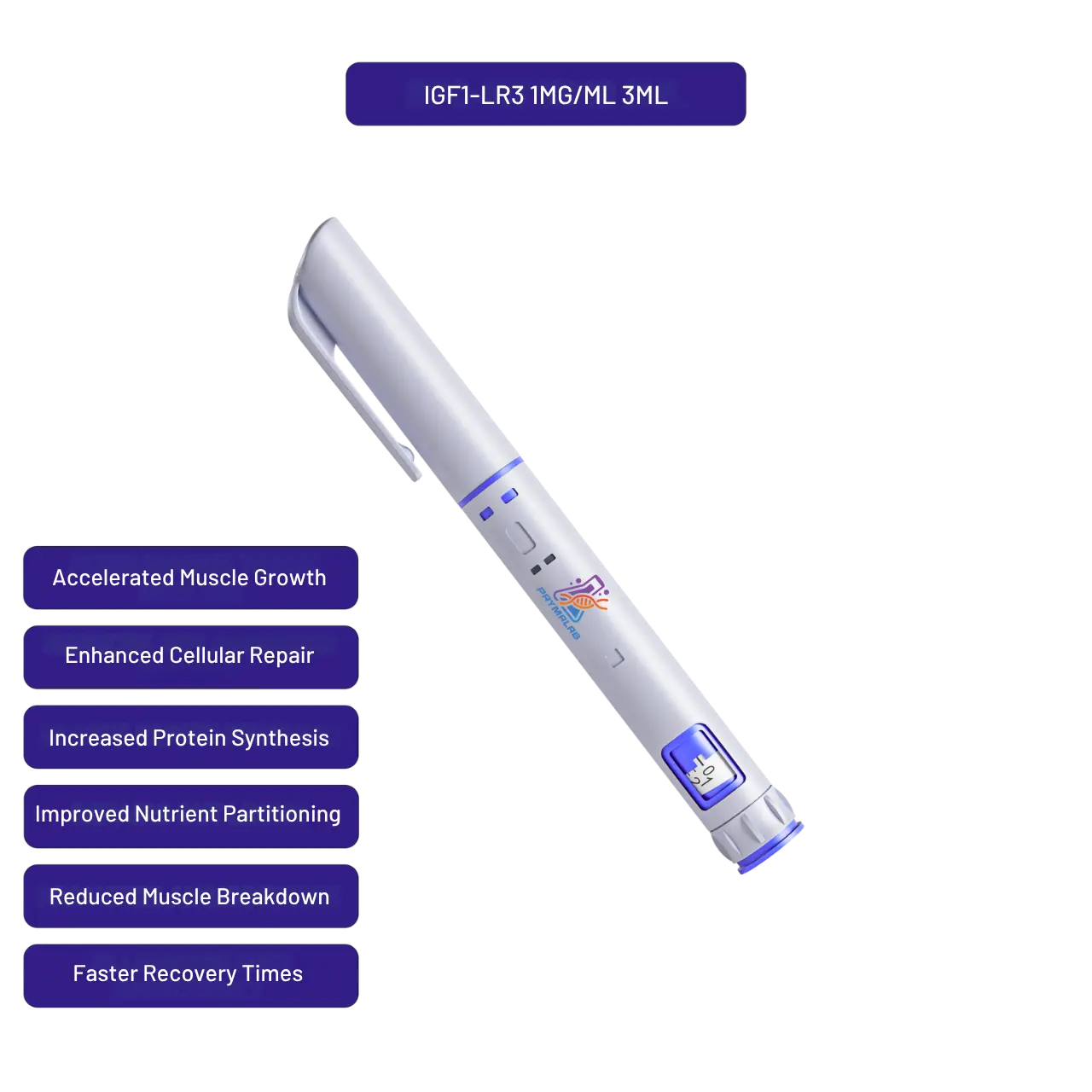
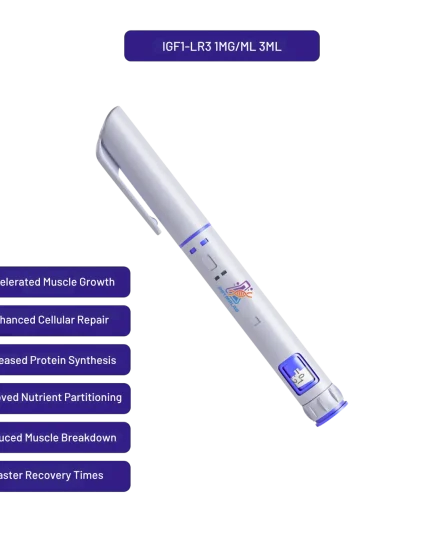
IGF-1 LR3 autoinjector is a pre-filled device supplying Long R3 IGF-1, an 83-residue analogue of insulin-like growth factor 1. Two modifications distinguish it from the 70-residue native sequence: an arginine substitution at position 3 and a 13-residue extension at the amino terminus.
Specification Table
IGF-1 LR3 verified structural and format data
| Property |
Value |
| Compound |
Long R3 IGF-1 |
| Common designation |
IGF-1 LR3 |
| Parent molecule |
Insulin-like growth factor 1, 70 residues |
| Residue count |
83 |
| Modification 1 |
Glutamate to arginine substitution at position 3 |
| Modification 2 |
13-residue extension at the amino terminus |
| Approximate molecular weight |
9111 Da |
| Disulfide bonds |
Three, as in native IGF-1 |
| Molecular target |
IGF-1 receptor (IGF1R), a receptor tyrosine kinase |
| Principal downstream pathways |
PI3K-AKT and RAS-MAPK |
| Purpose of the Arg3 substitution |
Reduces affinity for IGF binding proteins |
| Purpose of the N-terminal extension |
Further reduces IGFBP association |
| Binding protein family |
IGFBP-1 through IGFBP-6 |
| Format |
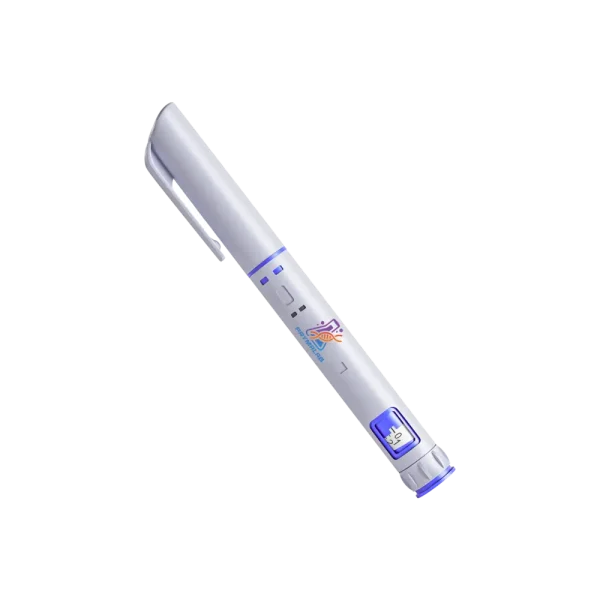
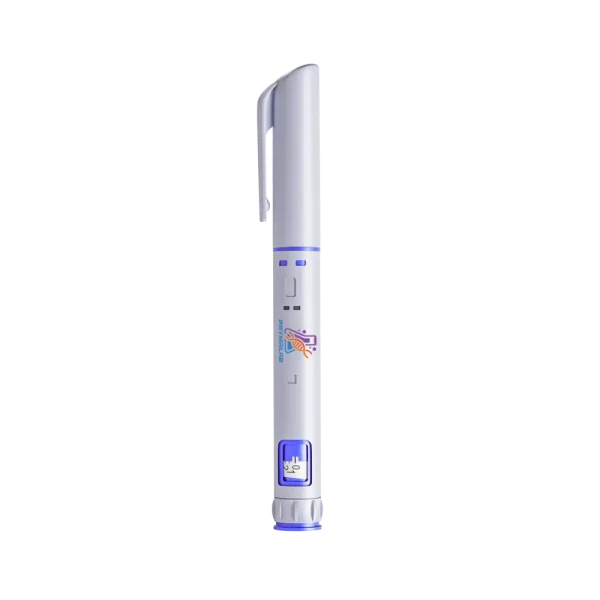
Pre-filled autoinjector device |
| Physical state |
Solution, supplied ready-filled |
| Appearance |
Clear colourless solution |
| Purity |
Per lot-specific certificate of analysis |
| Storage |
2-8°C, protected from light. Do not freeze the device |
| Regulatory status |
No approved human or veterinary formulation in any jurisdiction |
What Do the Two Modifications Actually Change?
The name behind the IGF-1 LR3 autoinjector encodes both modifications, and each addresses the same problem from a different angle.
Native IGF-1 in circulation is almost entirely bound to IGF binding proteins, principally IGFBP-3 in a ternary complex with the acid-labile subunit. Free IGF-1 represents a very small fraction of the total, and the binding proteins control how much is available to reach the receptor.
The R3 modification substitutes arginine for glutamate at position 3. Position 3 sits within the region contacting IGFBPs, and replacing an acidic residue with a basic one disrupts that interaction substantially while leaving receptor binding largely intact.
The Long modification adds thirteen residues to the amino terminus. That extension provides steric interference with binding protein association, compounding the effect of the substitution.
The combined finding is an analogue with markedly reduced binding protein affinity, which in an experimental system means a much larger proportion remains free. That is the entire design rationale and it explains why the analogue exists at all.
Why Does Reduced Binding Protein Affinity Matter Experimentally?
In cell culture, the binding protein question is subtler than in a whole organism and is frequently overlooked.
Many cultured cell types secrete IGF binding proteins into the medium. Native IGF-1 added to such a culture is partially sequestered by proteins the cells themselves produced, so the effective free concentration is lower than the nominal one and varies with cell type, density and time.
That variability is a real source of irreproducibility. Two laboratories adding the same nominal concentration of native IGF-1 to different cell lines can be delivering quite different free concentrations to the receptor.
An analogue with reduced binding protein affinity largely removes that variable. The nominal concentration approximates the free concentration, which makes concentration-response relationships more interpretable and more transportable between systems.
Serum in the medium compounds the issue, since serum contains binding proteins independently of what the cells secrete. Serum-free or reduced-serum conditions are worth considering for any careful IGF work, and reporting the serum condition is necessary for the finding to be interpretable.
What Does IGF-1 Receptor Signalling Involve?
The receptor is a tyrosine kinase and its signalling architecture is among the better characterised in cell biology.
IGF1R is a disulfide-linked heterotetramer of two alpha and two beta subunits. Ligand binding to the extracellular alpha subunits produces a conformational change that activates the intracellular beta subunit kinase domains, which trans-phosphorylate each other.
Phosphorylated receptor recruits adaptor proteins, principally IRS-1 and Shc. IRS-1 phosphorylation leads into the PI3K-AKT arm. Shc feeds the RAS-MAPK arm. Both are active downstream of this receptor and their relative contribution varies by cell type.
Substantial homology exists between IGF1R and the insulin receptor, and hybrid receptors containing one half of each are formed in cells expressing both. Those hybrids bind IGF-1 with higher affinity than insulin, which complicates attribution of any effect to a single receptor species.
Distinguishing IGF1R-mediated effects from insulin receptor and hybrid receptor contributions requires either receptor-specific blocking antibodies or genetic manipulation, and pharmacological inhibitors in this area are generally not clean enough to do it alone.
What Applies to the Device Format Specifically?
A pre-filled solution-state device carries considerations that a lyophilized vial does not, and for a protein of this size several matter.
At 83 residues with three disulfide bonds, this is a folded protein rather than a short flexible peptide. Its activity depends on maintaining that fold, and solution-state storage exposes it to aggregation and to disulfide scrambling over time.
Freezing is specifically contraindicated. Ice formation concentrates solutes in the remaining liquid phase and creates ice-water interfaces, both of which promote protein aggregation. A sealed device also risks mechanical damage from the volume change.
Agitation should be minimised. Proteins denature at air-liquid interfaces, and shaking a solution-state protein preparation generates those interfaces continuously. Devices should be handled gently rather than inverted repeatedly or shaken.
Visual inspection before use is meaningful for a protein preparation. Cloudiness or visible particulate indicates aggregation and the unit should be rejected rather than used, since aggregated protein has lost the fold that determines its activity.
What Should IGF-1 LR3 Autoinjector Work Control For?
Growth factor work has control requirements that are widely known and inconsistently applied, and several are specific to this analogue.
A native IGF-1 comparator arm establishes what the modifications contribute. Without it, an effect attributed to the analogue cannot be separated from an effect the parent protein would also produce, and the binding protein rationale goes untested.
Serum condition must be stated and ideally controlled. Serum contributes binding proteins independently of the cells, so the same nominal concentration delivers different free concentrations in ten percent serum versus serum-free medium.
Binding protein measurement in the conditioned medium is worth doing where the question concerns availability. Cells secrete these proteins at rates that vary with type, density and time, and measuring rather than assuming removes a hidden variable.
Receptor specificity requires attention because of insulin receptor homology and hybrid receptor formation. At higher concentrations this analogue can engage the insulin receptor, and attributing an effect to IGF1R requires either a blocking antibody or genetic separation.
A concentration-response curve rather than a single point is necessary for any of the above to be interpretable, since the receptor cross-reactivity is concentration-dependent and a single high concentration sits where specificity is weakest.
What Does the Ternary Complex Explain?
The way native growth factor circulates has a structural basis worth understanding, because it explains why the modifications on this analogue work at all.
Most circulating IGF-1 exists in a complex of three components: the growth factor itself, IGFBP-3 or IGFBP-5, and a third protein called the acid-labile subunit. The assembly is roughly 150 kilodaltons.
Size is the point. A complex of that mass does not cross capillary endothelium readily, so the ternary complex acts as a reservoir confining the growth factor to the vascular compartment rather than allowing free distribution.
Binary complexes of growth factor with binding protein alone are much smaller and do cross, which means the distribution of the molecule between ternary complex, binary complex and free form determines where it can act.
An analogue with reduced binding protein affinity does not assemble into either complex efficiently, so it remains largely free. That is the entire functional consequence of the modifications, expressed at the level of the transport system rather than the receptor.
In cell culture the acid-labile subunit is generally absent, so ternary complexes do not form and only the binary interaction is relevant, which is a difference worth holding in mind when reading in vivo work alongside culture work.
What Belongs in an IGF-1 LR3 Autoinjector Method Description?
Growth factor methods are frequently underspecified, and four fields would resolve most of that ambiguity.
The analogue used, named precisely. Long R3, DES(1-3) and native sequence are three different molecules with different masses, and writing only IGF-1 leaves a reader unable to reproduce the work.
Concentration expressed in molar terms rather than mass per volume, since the analogues differ in molecular weight by more than twenty percent and a mass concentration is not comparable across them.
Serum condition, stated as percentage and type, or serum-free. Binding protein content follows directly from it and determines free concentration.
Format and storage history where an IGF-1 LR3 autoinjector was the source, since a solution-state folded protein carries an aggregation history that a freshly reconstituted lyophilate does not.
Storage and Handling in Laboratory Practice
An IGF-1 LR3 autoinjector wants refrigeration, protection from light, no freezing, handled gently, and inspected before every use.
Maintain 2-8°C continuously. Return the device promptly after use rather than leaving it at ambient temperature, since aggregation proceeds faster at higher temperature and is irreversible once it occurs.
Keep the device in original packaging until immediately before use, which addresses light exposure and protects the mechanism.
Do not freeze under any circumstances unless the manufacturer specifically directs it. This is the single most consequential handling instruction for a solution-state folded protein.
Log the lot, the manufacture date, the full storage history including any temperature excursion, and every date of use. For a protein preparation the storage history bears directly on whether the material is still what the label says.
A final note concerns comparison across published work. Because three IGF-1 species are in common research use and papers frequently write only IGF-1, reading a methods section carefully is necessary before comparing concentrations across studies.
Where the species is unstated, the concentration is uninterpretable. Where it is stated in mass terms without a molecular weight, the conversion has to be inferred, and inference is where the twenty percent error described above enters.
Stating both the species and the molar concentration removes the problem at source.
Published Literature
References verified against the publisher record. IGF-1 biology rests on an extensive independent literature spanning several decades.
- Francis GL, Ross M, Ballard FJ, Milner SJ, Senn C, McNeil KA, Wallace JC, King R, Wells JR. Journal of Molecular Endocrinology. 1992;8(3):213-223.
- Baxter RC. Nature Reviews Endocrinology. 2014;10(4):201-212.
- LeRoith D, Roberts CT Jr. Cancer Letters. 2003;195(2):127-137.
- Firth SM, Baxter RC. Endocrine Reviews. 2002;23(6):824-854.
- Denley A, Cosgrove LJ, Booker GW, Wallace JC, Forbes BE. Cytokine and Growth Factor Reviews. 2005;16(4-5):421-439.
Frequently Asked Questions
What is the IGF-1 LR3 autoinjector?
A pre-filled device supplying Long R3 IGF-1, an 83-residue analogue of insulin-like growth factor 1 carrying two modifications relative to the 70-residue native sequence. Laboratory research use only and not approved for human or veterinary use anywhere.
What are the two modifications?
An arginine substituted for glutamate at position 3, and a 13-residue extension at the amino terminus. The name Long R3 encodes both, with Long referring to the extension and R3 to the arginine at position three.
What do those modifications accomplish?
Both reduce affinity for IGF binding proteins. Position 3 sits within the IGFBP contact region, so replacing an acidic residue with a basic one disrupts that interaction, while the N-terminal extension adds steric interference compounding the effect.
Why does binding protein affinity matter?
Because native IGF-1 in circulation is almost entirely bound, principally to IGFBP-3 in a ternary complex, with free IGF-1 representing a very small fraction. The binding proteins control how much is actually available to reach the receptor.
How does this affect cell culture work?
Many cultured cell types secrete binding proteins into the medium, so native IGF-1 added to such a culture is partially sequestered and the effective free concentration is lower than nominal, varying with cell type, density and time.
Is that a real source of irreproducibility?
Yes. Two laboratories adding the same nominal concentration of native IGF-1 to different cell lines can deliver quite different free concentrations to the receptor. An analogue with reduced binding protein affinity largely removes that variable.
Does serum complicate this?
Considerably, since serum contains binding proteins independently of what the cells secrete. Serum-free or reduced-serum conditions are worth considering for careful IGF work, and the serum condition must be reported for a finding to be interpretable.
What does IGF-1 receptor signalling involve?
A disulfide-linked heterotetramer of two alpha and two beta subunits. Ligand binding activates the intracellular kinase domains, which recruit IRS-1 feeding the PI3K-AKT arm and Shc feeding the RAS-MAPK arm, with relative contribution varying by cell type.
What complicates receptor attribution?
Hybrid receptors. Substantial homology exists between IGF1R and the insulin receptor, and cells expressing both form hybrids containing one half of each. Those hybrids bind IGF-1 with higher affinity than insulin, making single-receptor attribution difficult.
Can the device be frozen?
No, and this is the most consequential handling instruction for this product. Ice formation concentrates solutes and creates ice-water interfaces, both of which promote irreversible protein aggregation, and a sealed device also risks mechanical damage from the volume change.
Compliance Statement
IGF-1 LR3 is sold exclusively for laboratory research use. It is not a drug, food, or cosmetic product, and it is not a dietary product of any kind. It is not approved by the FDA or any comparable authority for human or veterinary use, and the pre-filled device format does not alter that status in any way. This product is not intended to diagnose, treat, cure, or prevent any disease. It must not be given to humans or animals. Purchase is restricted to qualified researchers and institutions operating within applicable laws. All handling is the responsibility of the purchasing laboratory.














15 reviews for Preloaded Autoinjector | IGF1 LR3 | 3ml Pen | 1mg/ml